« 2007年02月25日 | TOP | 2007年02月27日 »
金沢市の説明を英文で探す(2007年02月26日 16:46)
URLを貼っておきます。
Kanazawa City http://wikitravel.org/en/Kanazawa http://www.city.kanazawa.ishikawa.jp/index_e.html
Kanazawa city Tourist Association http://www.city.kanazawa.ishikawa.jp/index_e.html
Kanazawa Castle Park http://www.pref.ishikawa.jp/siro-niwa/kanazawajou/index_e.html
Kenroku-en Garden http://www.jref.com/practical/kenrokuen_garden.shtml
Ishikawa Ken http://www.hot-ishikawa.jp/f-lang/english/
Kanazawa is one of the overlooked jewels of Japanese tourism.
Kanazawa is famous for rain. A local proverb says "even if you forget your lunchbox, don't forget your umbrella".
It is never a good idea to bank on it being fine in Kanazawa, and winters in particular are cold and grey.
The viewpoint in the Kanazawa city is Kenroku-en Garden, Kanazawa Castle Site, Nagamachi Samurai District, Ninja Temple, and 21st Century Museum of Contemporary Art, etc.
投稿者 masuda : | トラックバック
九谷焼の説明を英語でしたいので探す(2007年02月26日 15:32)
九谷焼の歴史などの英文ページを探す。
石川県情報書府:http://shofu.pref.ishikawa.jp/shofu/kutani/index_e.htm
http://www.aisf.or.jp/~jaanus/deta/k/kutaniyaki.htm
それと九谷焼の商品を購入したときにパンレットが付いてくる。その時のパンフレットに英文があった。

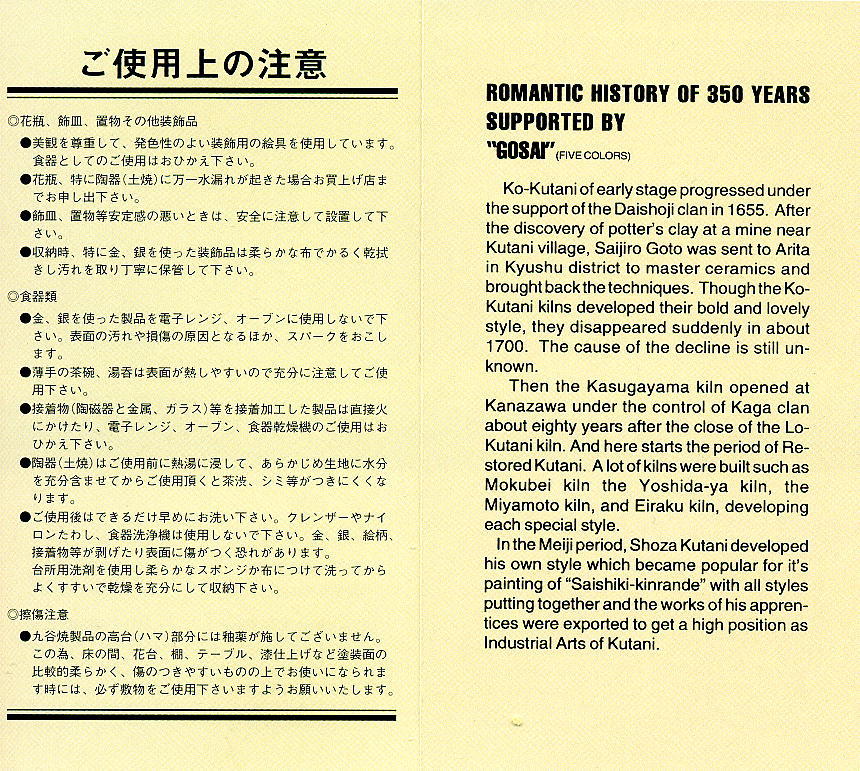
以下、その英文
ROMANTIC HISTORY OF 350 YEARS SUPPORTED BY "GOSAI"(FIVE COLORS)
"五彩"によって支持された350年のロマンチックな歴史(5つの色)
Ko-Kutani of early stage progressed under the support of the Daishoji clan in 1655. After the discovery of potter's clay at a mine near Kutani village, Saijiro Goto was sent to Arita in Kyushu district to master ceramics and brought back the techniques. Though the Ko-Kutani kilns developed their bold and lovely style, they disappeared suddenly in about 1700. The cause of the decline is still unknown.
Then the Kasugayama kiln opened at Kanazawa under the control of Kaga clan about eighty years after the close of the Ko-Kutani kiln. And here starts the period of Restored Kutani. A lot of kilns were built such as Mokubei kiln the Yoshida-ya kiln, the Miyamoto kiln, and Eiraku kiln, developing each special style.
In the Meiji period, Shoza Kutani developed his own stlyle which became popular for it's painting of "Saishiki-kinrande" with all styles putting together and the works of his apprentices were exported to get a high position as Industrial Arts of Kutani.
投稿者 masuda : | トラックバック
蛍烏賊(ホタルイカ)を炭火で焼きたいのでコンロを探す(2007年02月26日 13:50)
石川県珠洲市で珪藻土(けいそうど)を使って作られたコンロがあることを知る。
で、一番小さいコンロを探していたところ、本日、石川県地場産業振興センターの展示場で見つけた。
能登ダイヤ工業株式会社の「奥能登こんろ4号」だ。
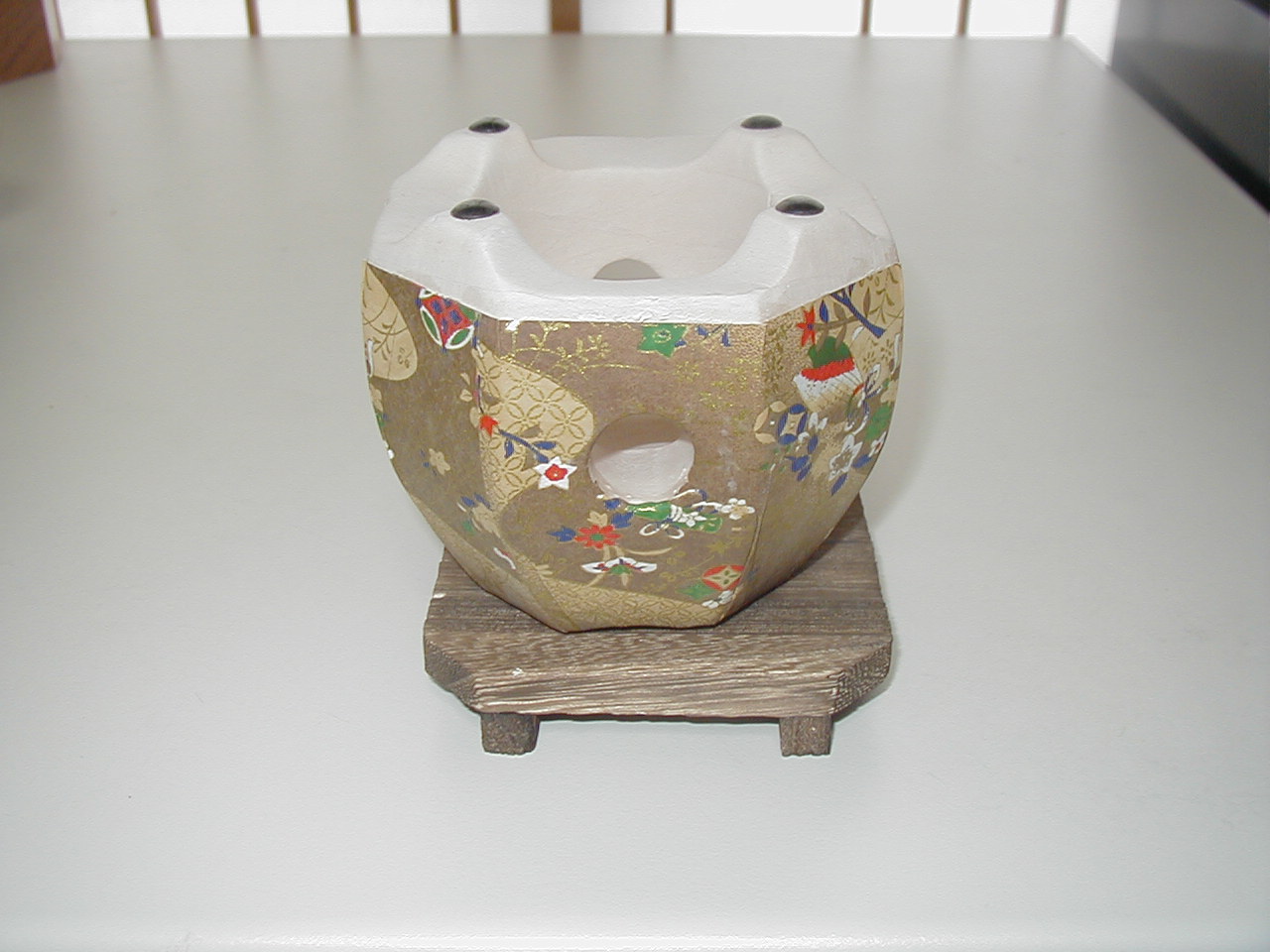
他にも3社から発売されていたが、一番小さいのは能登ダイヤ工業さんかな?
コンロを作っている会社
有限会社丸和工業
能登燃焼器工業株式会社
株式会社鍵主工業
それと有限会社丸和工業さんの説明を英文に仕上げてみた。英語は不得意なのでご容赦を・・・
英語が先で後ろに日本文をつけてある。
--ここから--
What is the diatom soil? 珪藻土とは。
Deposit(堆積物) that consists of remains of diatom that is phytoplankton's main composition kind.
植物プランクトンの主要な構成種である珪藻の遺骸からなる堆積物。
The principal ingredient is Ni oxidation silicon hydrate. White, the ash gray, and yellow, etc. are abundant water permeability, light, and are fragile in doing the porous quality.
主成分はニ酸化珪素水化物。白色・灰白色・黄色などをなし多孔質で吸水性に富み軽くてもろい。
It causes it also in lakes and marshes and the hot spring besides bottom of the sea. It is used for the filtration supplementary agent, the plate powder, the fireproof material, and the soil improvement medicine, etc.
海底のほか湖沼・温泉にも生ずる。ろ過助剤・磨き粉・耐火材・土壌改良剤などに使用される。
What is "Cut out" stove? 「切出し」焜炉とは。
The diatom soil is unlimitedly around Suzu City in Noto Peninsula.
珪藻土は能登半島の珠洲市周辺に無尽蔵にある。
There are two kinds of stoves made from the diatom soil in Japan.
日本で、珪藻土で作られるコンロは2種類ある。
One is "Kneading thing", and another is "Cut out".
一つは「練り物」で、もう一つは「切出し」である。
The kneading thing is made the diatom soil that becomes a raw material a powder, kneaded, and made.
練り物は、原料となる珪藻土を粉末にして練り、作る。
On the other hand, cutting out cuts out diatom Tsuchiiwa, and turns over the inside.
一方、切出しは、珪藻土岩を切り出し、内部をくりぬく。
--ここまで--
投稿者 masuda : | トラックバック
MySpaceにページを持った(2007年02月26日 08:06)
http://www.myspace.com/machu1964が私のMySpaceページだ。
基本的に英語で書き、日本語でも表記するようにしたいと考えて作った。
3月12日〜シアトルへ行くために週に1回の英語のレッスンもしている。遅々として進まないが、まったく進んでいないかと言えばそうでもない。
まず、英文には抵抗が無くなった。
毎日英語で日記を書いていこう。
投稿者 masuda : | トラックバック